Opening Hearts at Springhill Prison

November 7:  Today Abrahamic Reunion’s UK tour had a presentation at Springhill Prison in Buckinghamshire, England.

Abrahamic Reunion Peacemakers Sheikh Ghassan Manasra (Director), Rabbi Mordechai Zeller (a former resident of Israel serving as the current Rabbi for Cambridge University, and a trustee for the Abrahamic Reunion in the UK), and I, Reverend Cherag Anna Less PhD, (AR Executive Director) together with Abrahamic Reunion youth leader, Zaynab Manasra, and our UK Abrahamic Reunion team, Michael and Amanda Kenton, and Yvonne Dixon the Quaker Chaplain at Springhill Prison, met to offer a presentation to approximately 80 inmates, staff members and chaplains at Springhill Prison.

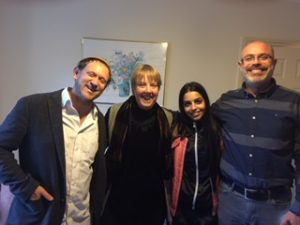
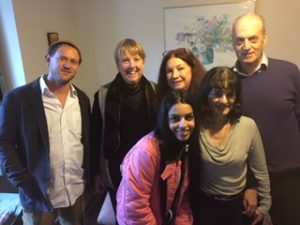
No photos were allowed in the prison, however this photo was taken beforehand of everyone going (minus Sheikh Ghassan who is taking this picture.)

Yvonne introduced us to the audience and spoke about Springhill’s history, which served as the training centre for British Special Forces during World War II. She explained that the gymnasium where we were giving our presentation was built by the prisoners and named after Britain’s first Muslim war heroine, Noor-un-Nisa Inayat Khan.

Although Springhill Prison shares the same grounds as Grendon Prison, where the Abrahamic Reunion had presented last year, Springhill has a very different population from that of Grendon Prison, which offers a therapeutic program for England’s most dangerous and violent criminals.

Springhill is an open prison that supports the needs of about 335 long-term prisoners who are in the last few years of their sentence. At Springhill, prisoners train and prepare for their release, and participate in a resettlement program that allows them to work in jobs outside of the prison during daylight hours, and return to live in the prison when they are not working.

The majority of residents in our audience were Muslims and surprisingly for us, there were a number of Palestinians.

[wpex more=”Read more” less=”Read less”]

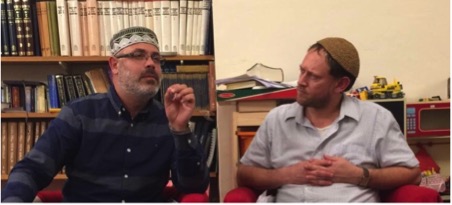
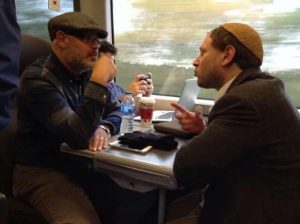
Sheikh Ghassan and Rabbi Mordechai prepare on the train to Springhill prison

The Muslim inmates eagerly gathered around Ghassan to speak with him in urgent, hushed Arabic while Mordechai and I made our presentations.

After all of us had spoken there was a Question and Answer period, and initially the tone of the inmate’s “questions”, which were directed at Mordechai, began as wounded and sceptical challenges that bordered on being aggressive.

But Ghassan immediately stepped in to skilfully navigate their hostility, and soothe them with quotes from the Quran and the Hadith.

He appealed to their innate desire for peace in ways that were culturally familiar for them, and once they felt their pain had been heard and responded to, they began to soften and calm down.

As Ghassan continued to raise their consciousness to a higher level, they gradually began to open their hearts to Mordechai (their preconceived enemy) and our other speakers, and an atmosphere of trust, hope and camaraderie began to take over.

By the time the evening was winding down the inmates were asking, “Are there more people like you?” “Are there more people who believe

Sheikh Ghassan and Rabbi Mordechai prepare on the train to Springhill prison

what you believe?” In other words, “Is it really safe, and possible, to love one another?” As they hugged Ghassan and Mordechai goodbye, and shook my hand, they admitted what “a good guy” Mordechai was, and they shared that they had never met people like us, and this evening offered them the possibility to consider a new ending to an old story that always left them feeling like the victim.  They asked how they could get in touch with us when they “get out.”

The authorities and staff at Springhill also immediately came forward at the end of the program to discuss our next steps together regarding offering programs, and in-depth trainings, here, and in other prisons they are responsible for.

As we packed our things to leave, we could finally exhale and thank the dedicated staff at Springhill.  We send a special thanks to Chaplain Co-ordinator Brenda Davies and Yvonne Dixon for their support of the Abrahamic Reunion.

[/wpex]


An Interfaith Service at Springhill Prison

Thanks to the hard work of Yvonne Dixon, Latifa Shahab Laker and Gulrukh Patel, an inspired Interfaith Service was held at Springhill Prison on October 25th 2012. The service took place in conjunction with the unveiling of a new Gym built entirely by the prisoners and dedicated to Noor Inayat Khan in recognition of her heroic deeds during World War Two.

Springhill was the training centre for the Special Operations Executive during the war and where all of Noor’s radio transmissions from occupied Paris, would have been received. In 1953 Springhill became the first open prison in the UK and is now a resettlement prison where detainees are prepared for re-entry into society. Yvonne is acting chaplain there and initiated talks with the Governor about offering an Interfaith Service called a Universal Worship Service in honour of Noor. During preliminary discussions he came up with the idea of dedicating the gym as a tribute to her. Naturally we were all delighted that the prison had taken Noor’s story into its heart.

The service was conducted in the presence of prisoners, guests and members of the UK Sufi Order. Guests and prisoners from different faiths were invited to participate by reciting scriptures from their respective traditions. One of the prisoners also made an offering from Noor’s Jataka Tales.

[wpex more=”Read more” less=”Read less”]

Shrabani Basu, the tour de force behind the Noor un Nisa statue campaign joined us and opened the evening with a short talk on Noor’s life. Shrabani enthralled the prisoners with stories of Noor’s bravery and astonishing resilience.

The service honoured the different faith with readings, music and a candle being lit for each of the faiths. During the service we were encouraged to reflect upon our unique lives. Gulrukh gave a most inspiring sermon in which she conveyed Noor’s last word ‘liberte’. She then asked us all to contemplate what our last words might be. Then, once we’d recognised them, to enquire whether our lives were being lived in alignment with these words. Gazing around the room, I saw many eyes lighting up at this invitation. I then felt the power of participating in this self-enquiry together.

The feedback from the prisoners and staff was really positive; they remarked what a great opportunity it was for all to share in Noor’s inspirational story and that having the Universal Worship Service had illustrated the need and possibility of further interfaith dialogue.

Michael Kenton, who was a driving force behind the service, shared some anecdotes with me; apparently the governor had said that if any of the audience had wished to walk out at any time they certainly could have, so clearly everyone enjoyed the experience. He added to that, considering Spurs and Liverpool were playing that night he was most surprised that so many prisoners attended.

I circulated amongst the prisoners during the refreshments and received many questions and compliments about the service.

Britain’s first memorial to an Asian woman.

Two weeks later during remembrance week, the unveiling of a bust of Noor Inayat Khan by HRH The Princess Royal in London’s Gordon Square took place. The Khan family once lived on the square and Noor would have strolled in its gardens. Veterans of both the SOE and WAAF including Irene Warner, 91, who trained with Noor, were among the 300 who came out to honour her.

This momentous occasion was the result of 2 years of fundraising and campaigning by Shrabani Basu and her collaborators, whom she lovingly calls ‘Team Noor’. Shrabani in her welcoming address thanked all the supporters for bringing Noor back to Gordon Square, and then invited Princess Anne to conduct ceremonious proceedings.

After the unveiling, which was met with great applause, Princess Anne honoured Noor’s sacrifice saying stories such as Noor’s are ‘remarkable in their own right’ but have a real connection to make with the modern age through their ‘multi-cultural aspect’. HRH added that she hoped that the statue would serve as a reminder, encouraging people to ask; who was she? Why she was there? And, what could be achieved in her memory?

A deeply moving closing message from Hidayat Inayat-Khan then followed, read with great tenderness by his grandson Omar Inayat Khan. In his address Pia Hidayat paid tribute to his beloved sister’s passionate call for liberty for which she paid the ultimate price. He appealed to us to keep at heart the great ideals of harmony, which are so much needed in this troubled world today. A world in which concepts of human rights have not yet been understood by all as being the only truest guaranty for an everlasting peace among nations..

To close a single bugle played the last post followed by a poignant silence.

Sheikh ul Masheikh Mahmood Khan and his wife Harunissa came from their home in the Netherlands to be present. In an interview he commented; ‘Everyone – British, Indian and beyond – can take pride in what Noor did.”

It’s difficult to convey my feelings surrounding this occasion as at times I was overcome with emotion, but perhaps I could best describe the atmosphere as being pervaded with the dignity, courage, graciousness and nobility of soul that was Noor’s very essence.

Adapted by Michael Kenton from an article by Anne Marie Terry

[/wpex]


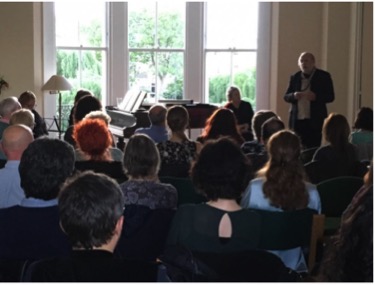
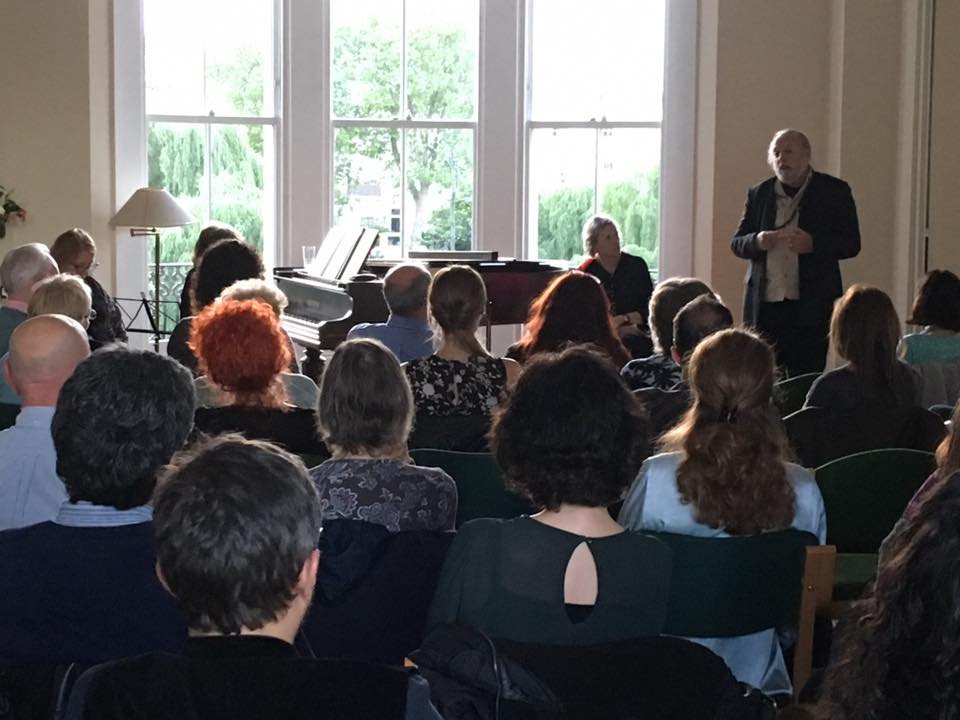
David Less, Chairman of the Abrahamic Reunion Board, speaking at an event organised by Abrahamic Reunion England at the Centre for Counselling and Psychotherapy Education in London.

David Less, Chairman of the Abrahamic Reunion Board, speaking at an event organised by Abrahamic Reunion England at the Centre for Counselling and Psychotherapy Education in London.

This was the third speaking tour to the UK that The Abrahamic Reunion’s International Executive Directors, Dr. Anna Less and Ghassan Manasra, have done on behalf of the Abrahamic Reunion. Anna’s husband David Less, another founding member and Chairman of the Board, accompanied them on part of this tour to hold a fundraiser in London for the Abrahamic Reunion, England.

While in London Anna, Ghassan and David worked with the AR UK team, founded by the Abrahamic Reunion England board members, Amanda and Michael Kenton.

This tour included speaking engagements at a prison, a synagogue, an interview on BBC radio, and many other exciting events coinciding with the beginning of Ramadan.

Darkness cannot drive out darkness; only light can do that. Hate cannot drive out hate; only love can do that.
Martin Luther King, Jr.

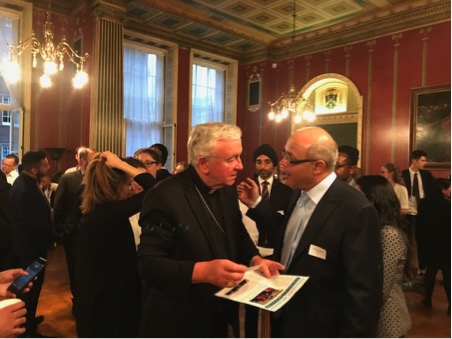
Catholic Cardinal of the UK with Sheik Ghassan Manasra at the Catholic Archbishop’s House in London.

We can never obtain peace in the outer world until we make peace with ourselves.
Dalai Lama

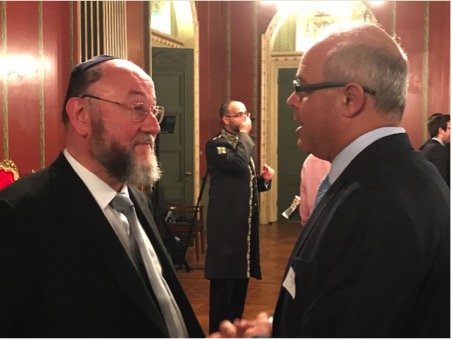
London Interfaith Iftar with Ephraim Mirvis, the Chief Rabbi of the United Hebrew Congregations of the Commonwealth, and Sheik Ghassan Manasra of the Abrahamic Reunion at the Catholic Archbishop’s House in London.

Man must first create peace in himself if he desires to see peace in the world; for lacking peace within, no effort of his can bring any result.
Hazrat Inayat Khan


The Zohar, Ibn Arabi, and Interreligious Text Study at Cambridge University

UK Speaking Tour, November 2017

Sheikh Ghassan Manasra and Rev. Cherag Anna Less Phd travel to London and the UK for a late-autumn speaking tour which also includes National Interfaith Week in the UK. They are joined by Sheikh Ghassan’s daughter and AR young adult leader Zeynab Manasra, Rabbi Mordechai Zeller (trustee to AR UK and Rabbi in residence at Cambridge University), and Michael & Amanda Kenton, co-founders of AR UK.

The Zohar, Interreligious Text Study at Cambridge University with Rabbi Mordechai Zeller, and Ibn Arabi
Today we traveled to Cambridge to meet with Abrahamic Reunion Peacemaker Rabbi Mordechai Zellar who is currently the Jewish Chaplain at Cambridge University. It is interfaith week in England, and Mordechai has invited the Abrahamic Reunion, and the Cambridge University Islamic Society (ISOC) to his weekly Zohar study group.

The word Zohar means “splendor” or “radiance” and it is considered to be the core text of Jewish mystical thought known as Kabbalah, which offers a mystical interpretation of the Bible.

Composed by kabbalist Rav Shimon bar Yochai, the Zohar is a set of twenty-three books that provide a commentary on biblical and spiritual matters in the form of conversations among spiritual masters. On the one hand it is a vast, comprehensive commentary on biblical matters, and on the other hand it is intended to be a guidebook for the lost divine nature of our souls, and the Zohar describes all of the spiritual states that the sole experiences as it evolves. At the end of this process, the soul achieves what Kabbalah refers to as “the end of correction,” the highest level of spiritual wholeness.

Often written as a cipher, the codes, metaphors, and cryptic language of the Zohar are designed to provide channels for spiritual energy.

Hidden for 900 years between the 2nd and 11th centuries, the Zohar began to be shared in the 16th century when The Holy Ari, Rabbi Isaac Luria (1534-1572) stated that from his time onward, the wisdom of Kabbalah was ready to be opened to everyone.

The topic of today’s interfaith study group will be the relationship between Abraham and his nephew Lot from the perspective of Judaism, and Islam.

Mordechai, Ghassan and I have had a few conference calls to prepare for this evening. When Ghassan mentions to Mordechai that he would like to use Ibn Arabi’s book “The Bezels of Wisdom” as his source for speaking about Abraham, Mordechai not only runs out to get Ghassan a current copy of the book from the store, he makes arrangements for us to visit Cambridge University’s research library to study some of the earliest known copies of this precious book.

Called by Muslims “the greatest master,” Ibn Arabi was a Sufi born in twelfth-century Spain. At the end of his life, while in Damascus Ibn Arabi had a vision that prompted him to write this book. He describes the experience in his preface.

“I saw the Apostle of God in a visitation…He had in his hand a book, and he said to me, “This is the book, “The Bezels of Wisdom”, take it and bring it to men that they might benefit from it.”

A “Bezel” is a setting on a ring, and in Arab culture this “Bezel” would have been set with a gem and engraved with the wearer’s name, to make the ring into a seal.

The “setting” that holds Ibn Arabi’s gem of spiritual wisdom, describes the author’s mystical insights through the lives of each of the prophets, and Ghassan wants to share with our group Ibn Arabi’s esoteric commentaries on the life of Abraham.

As we walk on cobblestone streets, through Cambridge’s medieval neighborhoods, we feel as though we have already begun a journey back in time.

Outside the Cambridge Library Itai Kagen, the son of Rabbi Ruth Kagen and Michael Kagan, who have participated in many Abrahamic Reunion events in Israel, comes running up to us to embrace Ghassan. Visiting from Hebrew University, Itai is living in London to do Biblical research. He has heard that Ghassan will be teaching with Mordechai in Cambridge, and has traveled with his wife 2 hours by train to attend Mordechai’s Zohar class so he can hear Mordechai and Ghassan teach together. While we use the library’s research room to study Ibn Al’ Arabi, he will be here to study an ancient Hebrew manuscript found in Egypt.

We enter the library bearing 2 forms of ID. Security is tighter here than at the prison we had entered together two days earlier.

We are escorted through a series of locked doors that require pass codes, to a room containing Cambridge University’s most valuable and precious books. Photos are forbidden as two ancient volumes are offered to us on pillows. Only one person, Estara, the research specialist has permission to touch the books, and turn the pages, which have been mounted on special paper to preserve them. One book was composed in the 14 century, and the other one was written in the 16 century. Several different scribes hand wrote each volume, as Estara points out where the script of each different scribe changes. We hover around Estara, as she turns the pages, and Ghassan begins to read out loud when he comes to the section on Abraham. Certain pages contain blank symbols in the midst of the hand written script. Ghassan explains these esoteric symbols are ciphers and amulets used to transmit realization and messages to the reader. The margins of the pages contain hand written notes in Arabic, Hebrew, and other ancient languages, the work of long ago scholars deciphering the esoteric contents for their own research.

Ghassan reads aloud to us and translates as he goes along. The whole experience has a mystical quality so different than reading on the Internet, or from a modern mass-produced book. And we are mesmerized by the experience.

We also take time to visit Itai at the table behind us, as he carefully sifts through the fragments of an ancient Hebrew manuscript that have been suspended between large sheets of plastic. He and Mordechai and Ghassan read it together and Itai explains that he can speak at least eleven ancient biblical languages, and he is here to do research for his professors at Hebrew University. He says he and Estara will meet us later at Mordchai’s Zohar class.

As we gather for our meeting about 25 people enter the room. As they introduce themselves I am quick to realize that this text study group is not going to be like any text study group I have attended before. This will be a meeting of biblical scholars. Although many are still students most are postgraduates doing advanced biblical study.

Mordechai begins by telling the story of Abraham and Lot’s relationship, in a historical context, then Mordechai begins to use the Zohar to peel back the outer layers of the story and interpret the symbology and metaphors it contains to reveal the story’s luminous esoteric core

After Mordechai speaks, Ghassan begins to share Ibn Arabi’s spiritual interpretation of these stories.

I am stunned by the similarities and I wonder what is the connection between these two authors? What journeys have transpired, and what exchange of knowledge has taken place to inform these two great works? Surly the influences must be there. The similarities are obvious to everyone, and the scholars offer informed speculations, that may have transpired, and identify scholarly connections within and between these two spiritual lineages.

I have participated in many text study groups before, but I have never experienced such a profound, spiritual state as I have had in this text study group, I am left with a luminous sense of awe, and a powerful sense of spiritual truth as I listen to these two interpretations.

I feel grateful that the enlightened spiritual leaders in the Abrahmic Reunion such as Sheikh Ghassan Mansara and Rabbi Mordechai Zellar, are able to guide participants in these text study programs to break through the academic shell that can imprison the spiritual experience that the authors intended their readers to have.


UK Speaking Tour, November 2017

Sheikh Ghassan Manasra and Rev. Cherag Anna Less Phd travel to London and the UK for a late-autumn speaking tour which also includes National Interfaith Week in the UK. They are joined by Sheikh Ghassan’s daughter and AR young adult leader Zeynab Manasra, Rabbi Mordechai Zeller (trustee to AR UK and Rabbi in residence at Cambridge University), and Michael & Amanda Kenton, co-founders of AR UK.

Dinner with Syrian Refugees in London
November 8:

A number of you may have read my blogs from May about our visit with Alaa and his family, who are refugees from Syria living in London. I have recopied those blogs from May here to provide you with a back ground for today’s story (Click here to read those accounts).

Ghassan and I have stayed in touch with Alaa since May and we have learned that his brother Bahaa finally gained permission in June to move to England and join them. After two years separation, he has been reunited with his wife and children and has been living here and adapting to life in England. We are anxious to meet him and also to learn how Alaa is doing.

Of the many people we met on our last journey Alaa was perhaps the most enthusiastic person we had encountered. He expressed a great desire to learn to become an Abrahamic Reunion facilitator for interfaith text study groups. He saw it as a great method for helping the mostly Muslim Syrian Refugee community in which he is clearly a leader, to practice their English, and learn about the culture and beliefs of the English community they had now become members of.

A few months ago these dreams crumbled when we were heartbroken to learn that in August, just as Alaa had finally gained permission to work in England, he was diagnosed with colon cancer, and since then he has had his entire colon removed, and is currently in his third round of chemotherapy. It seemed that things had suddenly taken such a dire and unexpected turn for this young family, who a few months ago seemed on the verge of beginning a hopeful new life.

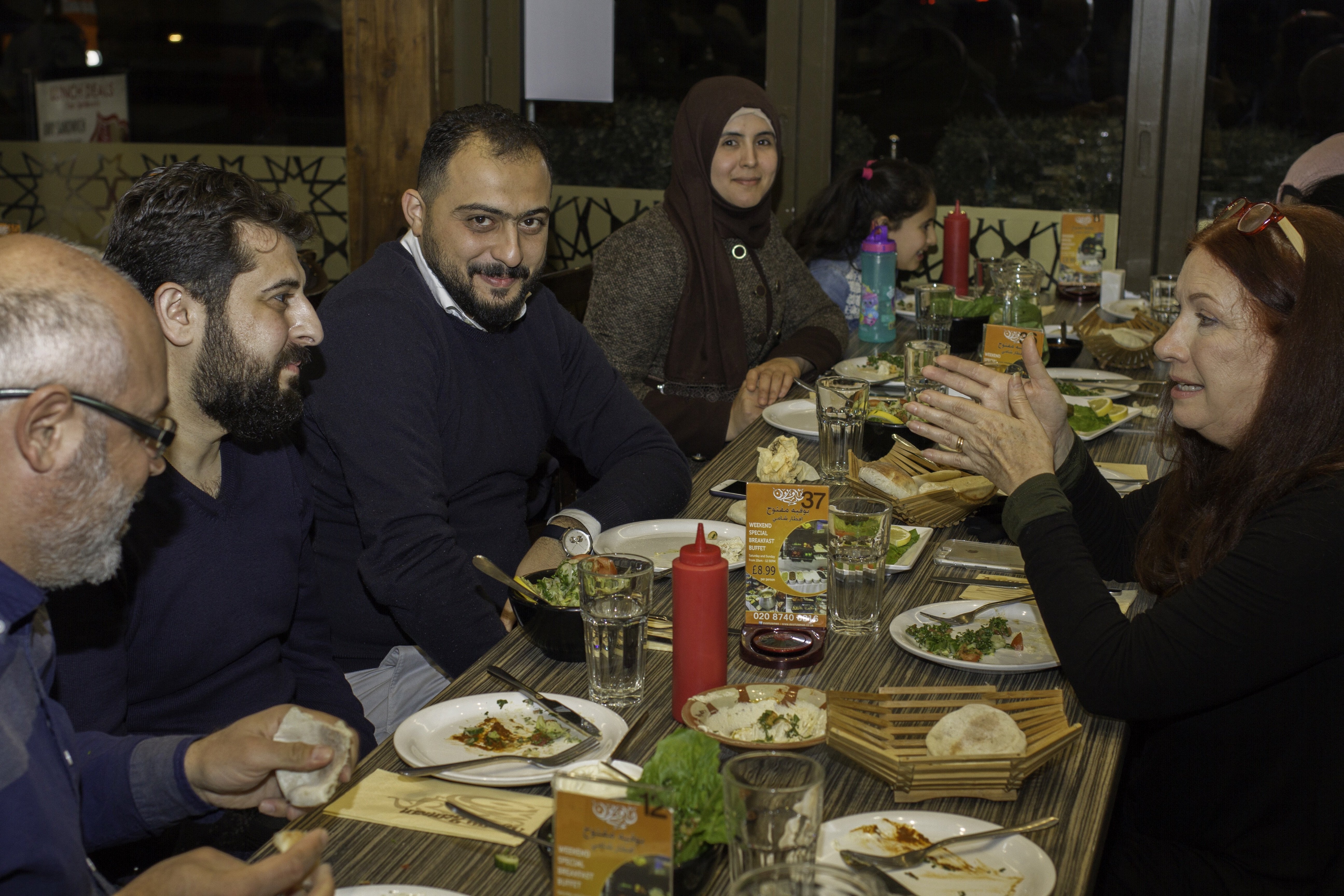
We have invited Alaa and his wife Taghrid and their daughter Yara as well as Alaa’s brother Bahaa and his wife and their two children to a nearby Syrian restaurant for dinner. They have told us that since leaving Syria over three years ago they have not been able to afford to go out to eat in a restaurant so we hoped this will be a special occasion for them.

The neighborhood where we stay in London is mostly inhabited by people from the Middle East. The grocery stores and restaurants advertise halal meat and feature foods common to that region of the world. The signs and menus are written in Arabic, and the staff is able to communicate with shoppers and diners in their native language. Women are typically dressed in full niqabs or hijabs. At times it is hard to remember we are in England, because it feels more like we are in a Middle Eastern country. We hope they will feel at home.

We are surprised when Alaa walks into the restaurant. He has a long beard and a full head of hair. He looks well, except for a sadness in his eyes. He explains that due to his low immune system doctors do not allow him to shave. We sit down to eat and they seem delighted to discuss the menu with the wait-staff in Arabic. The staff, who know us, and why we are here, are anxious to serve this family with love and kindness and treat them with special care.

It feels like a holiday and Alaa shyly shares, that tomorrow it is their one-year anniversary since arriving in England. As the evening continues he again expresses his desire to begin text study group for his community, but it is evident that his health is fragile and soon he appears very tired.

We take a short walk and they all express that they look forward to revisiting this neighborhood again soon as it is so comforting to be in a place that feels like home.

We stop on the sidewalk, to call an Uber and look up and see a big sign that says: “No one ever really dies.” Alaa walks over and takes a picture. It is a poignant moment as this young family considers their uncertain future.


Opening Hearts at Springhill Prison

UK Speaking Tour, November 2017

Sheikh Ghassan Manasra and Rev. Cherag Anna Less Phd travel to London and the UK for a late-autumn speaking tour which also includes National Interfaith Week in the UK. They are joined by Sheikh Ghassan’s daughter and AR young adult leader Zeynab Manasra, Rabbi Mordechai Zeller (trustee to AR UK and Rabbi in residence at Cambridge University), and Michael & Amanda Kenton, co-founders of AR UK.

Opening Hearts at Springfield Prison

November 7: Today Abrahamic Reunion’s UK tour had a presentation at Springhill Prison in Buckinghamshire, England.
Abrahamic Reunion Peacemakers Sheikh Ghassan Manasra (Director), Rabbi Mordechai Zeller (a former resident of Israel serving as the current Rabbi for Cambridge University, and a trustee for the Abrahamic Reunion in the UK), and I, Reverend Cherag Anna Less PhD, (AR Executive Director) together with Abrahamic Reunion youth leader, Zaynab Manasra, and our UK Abrahamic Reunion team, Michael and Amanda Kenton, and Yvonne Dixon the Quaker Chaplain at Springhill Prison, met to offer a presentation to approximately 80 inmates, staff members and chaplains at Springhill Prison.
Yvonne introduced us to the audience and spoke about Springhill’s history, which served as the training centre for British Special Forces during World War II. She explained that the gymnasium where we were giving our presentation was built by the prisoners and named after Britain’s first Muslim war heroine, Noor-un-Nisa Inayat Khan.

Although Springhill Prison shares the same grounds as Grendon Prison, where the Abrahamic Reunion had presented last year, Springhill has a very different population than Grendon Prison, which offers a therapeutic program for England’s most dangerous and violent criminals.

Springhill is an open prison that supports the needs of about 335 long-term prisoners who are in the last few years of their sentence. At Springhill prisoners train and prepare for their release, and participate in a resettlement program that allows them to work in jobs outside of the prison during daylight hours, and return to live in the prison when they are not working.

The majority of residents in our audience were Muslims and surprisingly for us, there were a number of Palestinians.

The Palestinians inmates eagerly gathered around Ghassan to speak with him in urgent, hushed Arabic while Mordechai and I made our presentations.

After all of us had spoken there was a Question and Answer period, and initially the tone of the inmate’s “questions”, which were directed at Mordechai, began as wounded and skeptical challenges that bordered on being aggressive.

But Ghassan immediately stepped in to skillfully navigate their hostility, and soothe them with quotes from the Quran and the Hadith.

He appealed to their innate desire for peace in ways that were culturally familiar for them, and once they felt their pain had been heard and responded to, they began to soften and calm down.

As Ghassan continued to raise their consciousness to a higher level, they reluctantly began to open their hearts to Mordechai (their preconceived enemy), and me (Mordechai’s naïve American accomplice, who didn’t understand their collective Muslim and Palestinian pain), and an atmosphere of trust, hope and camaraderie began to take over.

By the time the evening was winding down the inmates were asking, “Are there more people like you?” “Are there more people who believe what you believe?” In other words, “Is it really safe, and possible, to love one another?” As they hugged Ghassan and Mordechai goodbye, and shook my hand, they admitted what “a good guy” Mordechai was, and they shared that they had never met people like us, and this evening offered them the possibility to consider a new ending to an old story that always left them feeling like the victim. They asked how they could get in touch with us when they “get out.”
The authorities and staff at Springhill also immediately came forward at the end of the program to discuss our next steps together regarding offering programs, and in-depth trainings, here, and in other prisons they are responsible for.

As we packed our things to leave, we could finally exhale and thank the dedicated staff at Springhill. We send a special thanks to Chaplain Coordinator Brenda Davies and Yvonne Dixon for their support of the Abrahamic Reunion.


AR Brings Multifaith Healing & Peace-building to Swiss Alps

August 2017, Week-long workshop at the Zenith Institute in the Swiss-Italian Alps

In the weeks before our gathering at the Zenith Camp in Switzerland this past August of the summer of 2017 there was a deadly terror attack at the third holiest site in Islam, the Al-Aqsa Mosque on the Temple Mount in the old city of Jerusalem. The subsequent installation of metal detectors by Israel triggered weeks of rage, counter attacks, and violent clashes throughout the Holy Land, causing suffering and casualties on both sides.

Fear of provoking violence in the region has led Israel to a ban Jews from praying or making any religious expression on the Temple Mount, which is Judaism’s most sacred site.

The people in our international group at the Zenith Camp in Switzerland wondered why this had happened.

In a week-long interactive workshop led by a panel of Abrahamic Reunion peace builders that included Rabbi Mordechai Zeller of Cambridge University, Sheikh Ghassan Manasra from Nazareth Israel, Dr Anna Less, and David Less, our group learned the history, and through interactive group process explored models for peace in the Holy Land.

It was a profoundly healing week for participants, who came mostly from Germany, but also from Austria, Poland, Hungary, Switzerland, Chile, India, Australia, and America. Abrahamic Reunion peace builder Rabbi Zeller, who is currently the Rabbi at Cambridge University in England, but who grew up in Israel, and whose ancestors came from Berlin, was a major contributor both to the discussion and the healing process.

In addition, Sheikh Ghassan Manasra offered comfort and hope to the participants, whose home countries have been dealing with a massive influx of Muslim refugees from Syria, Palestine, Iraq, Afghanistan and Pakistan.

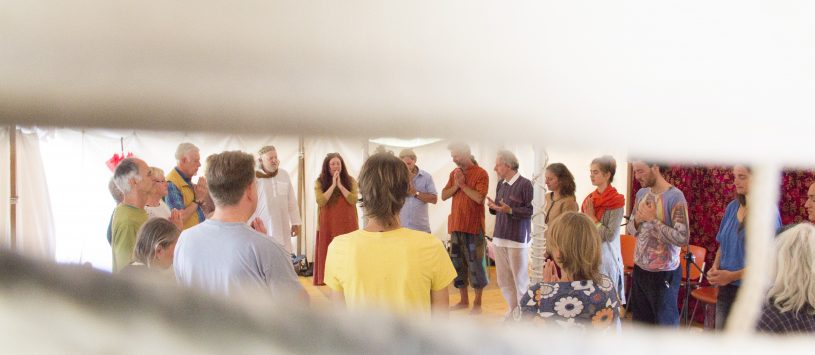
It is an influx that activates psychic scars in European communities still dealing with the legacy of World War II, and who struggle with fears of terrorism, and unfamiliar diversity, combined with guilt about their past. There has been little opportunity for people living in these communities to explore what is being activated in a dialogue process involving Jews and Muslims. Our interactive work, which used story telling, music, dance, deep inquiry, writing, and personal sharing, offered profound opportunities to heal the past, understand the present, and explore reassuring possibilities for the future.


Peacemakers discuss the Abrahamic Reunion


AR 2017 UK Peace Tour: Through the Lens of Dr. Anna Less

Peace Tour to the UK
Blogs through the lens of Dr. Anna Less, Co-Founder and International Executive Director of the Abrahamic Reunion, May 14th – June 6th 2017

Preface

This is the third speaking tour to the UK that The Abrahamic Reunion’s International Executive Directors, Dr. Anna Less and Ghassan Manasra, have done on behalf of the Abrahamic Reunion. Anna’s husband David Less, another founding member and Chairman of the Board, accompanied them on part of this tour to hold a fundraiser in London for the Abrahamic Reunion, before leaving for Germany, where he met with the Abrahamic Reunion’s German board.

While in London Anna, Ghassan and David worked with the AR UK team, founded by the AR UK board members Amanda and Michael Kenton.

Michael and Amanda did a brilliant job of organizing this tour, which included speaking engagements at a prison, a synagogue, an interview on BBC radio, and many other exciting events coinciding with the beginning of Ramadan.

The blogs represent the views and experiences of Dr. Less as she traveled through the UK with Ghassan and her husband on a trip that represents a significant step forward in creating a network of Abrahamic Reunion peace-builders in the UK.

The first blog recounts aspects of David and Anna’s interview with Clare Balding at the BBC 2, where Clare hosts a live weekly Sunday morning program from 7 – 9 AM that focuses on various faith issues, called Good Morning Sunday.

Blog 1: BBC2 Radio Interview

In the interview we begin by describing our work in the Holy Land; we talk about building bridges and connections, we describe our Iftar dinners, the text study groups, and our interfaith prayer gatherings in Jerusalem. We also talk about our upcoming fundraisers and programs. It feels like word about the AR’s work is really getting out to the UK, work that can offer so much to this country

David tells the following story:

Many years ago I was privileged to be mentored by a very great teacher who believed in the principle of harmony and love as the very essence of religion. He taught me to always look at life through the lens of two words: “what if?”

In my five decades of work, with religious leaders from many of our world’s faiths, I have often asked this question regarding the differences and variations of beliefs in religions.

What if we could honor the basic tenets, customs and traditions of any religion and yet pierce the veils of separation and find the living core common to all.

For the first time in our known history we are developing a global civilization. By knowing the basic practices and beliefs of the other we can become inwardly global.

Dialogue and understanding emerge naturally, when respect and knowledge are seminal.

Our group, the Abrahamic Reunion, has brought thousands of the inheritors of Abraham’s vision together to experience in houses of worship, in eating together, in sharing prayers together, an opportunity to rekindle our deeply rooted generations old memory of the family of Abraham.

What if we really lived that memory?

He concludes by reading Rumi’s poem

“Out beyond ideas of wrongdoing and right doing there is a field. I’ll meet you there. When the soul lies down in that grass the world is too full to talk about.” Rumi


Abrahamic Reunion Presents at Grendon Therapeutic Prison Near London

Dear Friends,

Last year when we came to England Ghassan and I spoke at a Quaker meeting. One of the attending Quaker ministers there, Yvonne Dixon was so moved by our talk that this year she arranged for David, Ghassan and I to speak at Grendon Prison where she is a chaplain.

Grendon Prison is the United Kingdom’s only therapeutic prison community for the treatment of serious sex offenders and violent criminals.

Below are some excerpts from an article about typical inmates at Grendon Prison that I read to prepare myself for my experience there. The article is about “Adam” and “Eddie (not their real names).”

Hello, I’m Adam. I’m serving life for murder. I killed my daughter.”

I wasn’t expecting that, writes Home Affairs Producer Ginny Sandringham. I was prepared for “I killed somebody”, or “I killed another gang member”, or “I killed my best mate because he was sleeping with my wife”, even. But this was something different. For the next few minutes I couldn’t think about anything else. His words echoed round my head as he carried on talking, telling me how much time he’d already served (eight years) and how much of his tariff he still had to serve (seven years).

“But the thing is”, he said, “I’m having to come to terms with what I’ve done because I have to talk about it every day with the guys here. I have to talk about my feelings and re-live the events leading up to the moment it happened.

“It’s what I signed up for. I knew the only way I was going to get through this was to come to Grendon (prison) and try and turn my life around by facing my demons.”

“I’m going to be taking part in psycho-drama soon”, he tells me, “which is where we act out the crime with the other inmates. I’ll have to go over the night I killed my daughter in detail, not only from my perspective but from my wife’s and my daughter’s.”

He looks absolutely terrified at the prospect.

At the end of his trial the judge told Adam: “You will have to live with what you have done for the rest of your life.”

But by coming to Grendon it’s even harder than that. He has to re-live it every day.

“Eddie”, a former gang member from Birmingham, is in for murder.

“All I had ever known was how to be part of a gang”, he said. “It was normal for me to have a gun in my hand. It was normal to be violent. When I got sent to prison my mates were already there.

“Coming here is probably the hardest thing I’ve ever done. (Here) You’re asked to talk about your feelings – something you never do in a gang. You’ve got to accept people who are different, and you have to control your anger. If you’re violent you’re out. It’s the complete opposite of being in a gang.”

This is the story that most of the inmates tell. The decision to come to Grendon is not an easy one.

To us on the outside it seems like a no-brainer: a high security jail surrounded by violent and desperate men or a prison where violence isn’t tolerated, you can wear your own clothes, and take part in therapy? But we haven’t lived the lives they have.

As we drive through the loops of barbed wire to enter the prison grounds, Yvonne explains that the Grendon Prison grounds also house the Spring Hill Prison, which was used during the Second World War as a radio transmission centre for Special Operations Executive . I am stunned to realize that my spiritual teacher’s sister Noor Inayat Kahn, who was trained as a radio operator sent her radio transmissions to these very grounds throughout the war. After the war, theses facilities were converted to become the UK’s first open prison. And in recent years the gymnasium here was dedicated to, and named after Noor Inayat Kahn.

I feel her hand reaching through time and space to guide this experience as we sign in and enter a chamber where we, and our bags are searched. They confiscate my jump drives and my pack of chewing gum.

“Some one could use it to make an impression of a key,” they explain.

We are escorted through hallways hung with excellent and very detailed artwork done by the prisoners with lots of time.

We enter a large and very cold gymnasium to set up for our presentation. We are told that our program is “very popular” and over 65 inmates have signed up to come. More chairs and benches are brought in. The prison therapists, clergy and staff also want to see what we are presenting.

We are introduced to the prison’s Imam and other clergy members.

As people file in and take their places, I can’t keep myself from trying to identify who is the staff and who are the inmates. Many people in the audience wear religious symbols, necklaces or beards that identify their religious affiliations.

David and Ghassan each speak eloquently about the work of the AR. When Ghassan speaks in Arabic and references the Quran and other Islamic texts, the Imam and various audience members light up and nod. When David speaks from the heart people around the room respond with profound recognition and applause.

I show the power point, and explain our activities, and afterwards there is a question and answer session. The questions are deep and heartfelt, and are followed by refreshments and an opportunity for the audience to speak with us individually.

A young Muslim inmate filled with light introduces him self. He tells us our work of bringing people from insular religious communities to meet with others was so important. He describes how growing up in an insular Muslim community in London had led to his radicalization and ultimately to this destiny.

We were told that in the after math of nine eleven he had murdered someone in retaliation for the media’s portrayal of Muslims, and he has been in prison since that time. I try to feel back through the years to nine eleven and consider what I had experienced in my own life since then and I try to imagine what he had experienced….

He said that in about 5 years perhaps he would released and it was his dream to be able to work with an organization like ours to promote interfaith harmony.

Another man approaching middle age with a long beard introduced himself as having an English, Jewish Mother, and a Muslim, Pakistani father. He shared had been in prison since the age of 17. He didn’t expect to be out soon. He wondered if he could work for the Abrahamic Reunion from within the prison. He said he had good computer skills and this work was exactly what he had been looking to do. He wondered if there was a way he could be of use to us, and to our work.

Others who had been involved in religiously motivated hate crimes came forward to express their support and admiration and share how important they felt our work was.

Chaplains came forward to ask how they and the inmates could learn to start an AR inspired interfaith study program.

As we rode the train home each of us described how profoundly and deeply moved we were by our experience there. We shared that it could potentially be a life altering experience for each of us personally and perhaps for the Abrahamic Reunion in general. We joked about presenting to a “captive audience” but our joking was an attempt to alleviate the profound sense of responsibility that each of us was experiencing as we continued to imagine how the Abrahamic Reunion could serve this community, and as we recognized the potentially far-reaching effects that work could have.

When I arrived home and opened my computer I had inquiries waiting from the directors and chaplains at the prison explaining that ‘radicalization’ in prisons is a very important topic that needs to be addressed and wondering how we could work together in the future.

We are absorbing this.