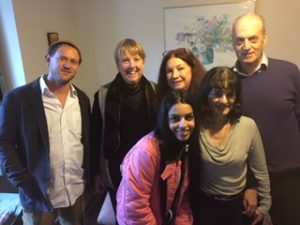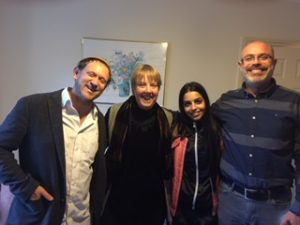
In April 2016, Anna Less and Ghassan Manasra came to England and spoke at a Quaker meeting. One of the attending Quaker ministers there, Yvonne Dixon was so moved by their talk that she subsequently arranged for David Less, Ghassan and Anna to speak at Grendon Prison where she is a chaplain.
Grendon Prison is the United Kingdom‘s only therapeutic prison community for the treatment of serious sex offenders and violent criminals.
Below are some excerpts from an article about typical inmates at Grendon Prison that we read to prepare ourselves for our experience there. The article is about “Adam” and “Eddie (not their real names).”
[wpex more=”Read more” less=”Read less”]
“Hello, I’m Adam. I’m serving life for murder. I killed my daughter.” (His daughter was about to turn four when he killed her).
I wasn’t expecting that, I was prepared for “I killed somebody”, or “I killed another gang member”, or “I killed my best friend because he was sleeping with my wife”, even. But this was something different. For the next few minutes I couldn’t think about anything else. His words echoed round my head as he carried on talking, telling me how much time he’d already served (eight years) and how much time he still had to serve (seven years).
“But the thing is”, he said, “I’m having to come to terms with what I’ve done because I have to talk about it every day with the guys here. I have to talk about my feelings and re-live the events leading up to the moment it happened.
“It’s what I signed up for. I knew the only way I was going to get through this was to come to Grendon (prison) and try and turn my life around by facing my demons.”
So what is next for Adam? A man who killed his own child in revenge for his wife’s infidelity?
“I’m going to be taking part in psycho-drama soon”, he tells me, “which is where we act out the crime with the other inmates. I’ll have to go over the night I killed my daughter in detail, not only from my perspective but from my wife’s and my daughter’s.”
He looks absolutely terrified at the prospect.
At the end of his trial the judge told Adam: “You will have to live with what you have done for the rest of your life.”
But by coming to Grendon it’s even harder than that. He has to re-live it every day.
“Eddie”, a former gang member from Birmingham, is in for murder.
“All I had ever known was how to be part of a gang”, he said. “It was normal for me to have a gun in my hand. It was normal to be violent. When I got sent to prison my mates were already there.
“Coming here is probably the hardest thing I’ve ever done. (Here) You’re asked to talk about your feelings – something you never do in a gang. You’ve got to accept people who are different, and you have to control your anger. If you’re violent you’re out. It’s the complete opposite of being in a gang.”
This is the story that most of the inmates tell. The decision to come to Grendon is not an easy one.
To us on the outside it seems like a no-brainer: a high security jail surrounded by violent and desperate men or a prison where violence isn’t tolerated, you can wear your own clothes, and take part in therapy? But we haven’t lived the lives they have.*
* To Read the full Channel 4 Article Click Here:https://www.channel4.com/news/
prison-jail-offenders-therapy- grendon-jail-video
 Anna wrote of the experience afterwards: “As we drive through the loops of barbed wire to enter the prison grounds, Yvonne explains that the Grendon Prison grounds also house the Spring Hill Prison, which was used during the Second World War as a radio transmission centre for Special Operations Executive. I am stunned to realise that my spiritual teacher’s sister, Noor Inayat Khan, who was trained as a radio operator, sent her radio transmissions to these very grounds throughout the war. After the war, these facilities were converted to become the UK’s first open prison. And in recent years the gymnasium here was dedicated to, and named after, Noor Inayat Kahn.
I feel her hand reaching through time and space to guide this experience…
as we sign in and enter a chamber where we and our bags are searched. They confiscate my USB stick and my pack of chewing gum.
“Someone could use it to make an impression of a key,” they explain.
We are escorted through hallways hung with excellent and very detailed artwork done by the prisoners.
We enter a large and very cold gymnasium to set up for our presentation. We are told that our programme is “very popular” and over 65 inmates have signed up to come. More chairs and benches are brought in. The prison therapists, clergy and staff also want to see what we are presenting.
We are introduced to the prison’s Imam and other clergy members.
As people file in and take their places, I can’t keep myself from trying to identify who is the staff and who are the inmates. Many people in the audience wear religious symbols, necklaces or beards that identify their religious affiliations.
David and Ghassan each speak eloquently about the work of the AR. When Ghassan speaks in Arabic and references the Quran and other Islamic texts, the Imam and various audience members light up and nod. When David speaks from the heart people around the room respond with profound recognition and applause.
I show the power point, and explain our activities, and afterwards there is a question and answer session; clearly the questions are deep and heartfelt. Afterwards, there are refreshments and an opportunity for the audience to speak with us individually.
A young Muslim inmate filled with light introduces himself. He tells us our work of bringing people from insular religious communities to meet with others was so important. He describes how growing up in an insular Muslim community in London had led to his radicalisation and ultimately to this destiny.
We were told that in the aftermath of 9/11 he had murdered someone in retaliation for the media’s portrayal of Muslims, and he has been in prison since that time. I try to feel back through the years to nine eleven and consider what I had experienced in my own life since then and I try to imagine what he had experienced….
He said that in about 5 years perhaps he will be released and it was his dream to be able to work with an organisation like ours to promote interfaith harmony.
Another man approaching middle age with a long beard introduced himself as having an English, Jewish Mother, and a Muslim, Pakistani father. He shared that he had been in prison since the age of 17. He didn’t expect to be out soon. He wondered if he could work for the Abrahamic Reunion from within the prison. He said he had good computer skills and this work was exactly what he had been looking to do. He wondered if there was a way he could be of use to us, and to our work.
Others who had been involved in religiously motivated hate crimes came forward to express their support and admiration and share how important they felt our work was.
Chaplains came forward to ask how they and the inmates could learn to start an AR inspired interfaith study program.
As we rode the train home each of us described how profoundly and deeply moved we were by our experience there. We shared that it could potentially be a life altering experience for each of us personally and perhaps for the Abrahamic Reunion in general. We joked about presenting to a “captive audience” but our joking was an attempt to alleviate the profound sense of responsibility that each of us was experiencing as we continued to imagine how the Abrahamic Reunion could serve this community and as we recognised the potentially far-reaching effects that interfaith work could have.
When I arrived home and opened my computer I had inquiries waiting from the directors and chaplains at the prison explaining that ‘radicalisation’ in prisons is a very important topic that needs to be addressed and wondering how we could work together in the future.’
We are absorbing this.
Really thank you.
Loving Regards
Anna Less
International Executive Director
[/wpex]

 November 7: Today Abrahamic Reunion’s UK tour had a presentation at Springhill Prison in Buckinghamshire, England.