Opening Hearts at Springhill Prison

November 7:  Today Abrahamic Reunion’s UK tour had a presentation at Springhill Prison in Buckinghamshire, England.

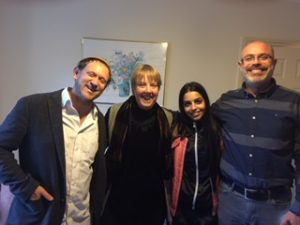
Abrahamic Reunion Peacemakers Sheikh Ghassan Manasra (Director), Rabbi Mordechai Zeller (a former resident of Israel serving as the current Rabbi for Cambridge University, and a trustee for the Abrahamic Reunion in the UK), and I, Reverend Cherag Anna Less PhD, (AR Executive Director) together with Abrahamic Reunion youth leader, Zaynab Manasra, and our UK Abrahamic Reunion team, Michael and Amanda Kenton, and Yvonne Dixon the Quaker Chaplain at Springhill Prison, met to offer a presentation to approximately 80 inmates, staff members and chaplains at Springhill Prison.
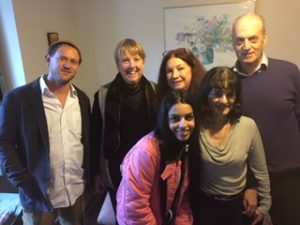
No photos were allowed in the prison, however this photo was taken beforehand of everyone going (minus Sheikh Ghassan who is taking this picture.)

Yvonne introduced us to the audience and spoke about Springhill’s history, which served as the training centre for British Special Forces during World War II. She explained that the gymnasium where we were giving our presentation was built by the prisoners and named after Britain’s first Muslim war heroine, Noor-un-Nisa Inayat Khan.

Although Springhill Prison shares the same grounds as Grendon Prison, where the Abrahamic Reunion had presented last year, Springhill has a very different population from that of Grendon Prison, which offers a therapeutic program for England’s most dangerous and violent criminals.

Springhill is an open prison that supports the needs of about 335 long-term prisoners who are in the last few years of their sentence. At Springhill, prisoners train and prepare for their release, and participate in a resettlement program that allows them to work in jobs outside of the prison during daylight hours, and return to live in the prison when they are not working.

The majority of residents in our audience were Muslims and surprisingly for us, there were a number of Palestinians.

[wpex more=”Read more” less=”Read less”]
Sheikh Ghassan and Rabbi Mordechai prepare on the train to Springhill prison

The Muslim inmates eagerly gathered around Ghassan to speak with him in urgent, hushed Arabic while Mordechai and I made our presentations.

After all of us had spoken there was a Question and Answer period, and initially the tone of the inmate’s “questions”, which were directed at Mordechai, began as wounded and sceptical challenges that bordered on being aggressive.

But Ghassan immediately stepped in to skilfully navigate their hostility, and soothe them with quotes from the Quran and the Hadith.

He appealed to their innate desire for peace in ways that were culturally familiar for them, and once they felt their pain had been heard and responded to, they began to soften and calm down.

As Ghassan continued to raise their consciousness to a higher level, they gradually began to open their hearts to Mordechai (their preconceived enemy) and our other speakers, and an atmosphere of trust, hope and camaraderie began to take over.

By the time the evening was winding down the inmates were asking, “Are there more people like you?” “Are there more people who believe
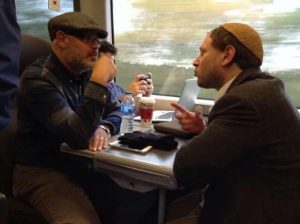
Sheikh Ghassan and Rabbi Mordechai prepare on the train to Springhill prison

what you believe?” In other words, “Is it really safe, and possible, to love one another?” As they hugged Ghassan and Mordechai goodbye, and shook my hand, they admitted what “a good guy” Mordechai was, and they shared that they had never met people like us, and this evening offered them the possibility to consider a new ending to an old story that always left them feeling like the victim.  They asked how they could get in touch with us when they “get out.”

The authorities and staff at Springhill also immediately came forward at the end of the program to discuss our next steps together regarding offering programs, and in-depth trainings, here, and in other prisons they are responsible for.

As we packed our things to leave, we could finally exhale and thank the dedicated staff at Springhill.  We send a special thanks to Chaplain Co-ordinator Brenda Davies and Yvonne Dixon for their support of the Abrahamic Reunion.

[/wpex]


An Interfaith Service at Springhill Prison

Thanks to the hard work of Yvonne Dixon, Latifa Shahab Laker and Gulrukh Patel, an inspired Interfaith Service was held at Springhill Prison on October 25th 2012. The service took place in conjunction with the unveiling of a new Gym built entirely by the prisoners and dedicated to Noor Inayat Khan in recognition of her heroic deeds during World War Two.

Springhill was the training centre for the Special Operations Executive during the war and where all of Noor’s radio transmissions from occupied Paris, would have been received. In 1953 Springhill became the first open prison in the UK and is now a resettlement prison where detainees are prepared for re-entry into society. Yvonne is acting chaplain there and initiated talks with the Governor about offering an Interfaith Service called a Universal Worship Service in honour of Noor. During preliminary discussions he came up with the idea of dedicating the gym as a tribute to her. Naturally we were all delighted that the prison had taken Noor’s story into its heart.

The service was conducted in the presence of prisoners, guests and members of the UK Sufi Order. Guests and prisoners from different faiths were invited to participate by reciting scriptures from their respective traditions. One of the prisoners also made an offering from Noor’s Jataka Tales.

[wpex more=”Read more” less=”Read less”]

Shrabani Basu, the tour de force behind the Noor un Nisa statue campaign joined us and opened the evening with a short talk on Noor’s life. Shrabani enthralled the prisoners with stories of Noor’s bravery and astonishing resilience.

The service honoured the different faith with readings, music and a candle being lit for each of the faiths. During the service we were encouraged to reflect upon our unique lives. Gulrukh gave a most inspiring sermon in which she conveyed Noor’s last word ‘liberte’. She then asked us all to contemplate what our last words might be. Then, once we’d recognised them, to enquire whether our lives were being lived in alignment with these words. Gazing around the room, I saw many eyes lighting up at this invitation. I then felt the power of participating in this self-enquiry together.

The feedback from the prisoners and staff was really positive; they remarked what a great opportunity it was for all to share in Noor’s inspirational story and that having the Universal Worship Service had illustrated the need and possibility of further interfaith dialogue.

Michael Kenton, who was a driving force behind the service, shared some anecdotes with me; apparently the governor had said that if any of the audience had wished to walk out at any time they certainly could have, so clearly everyone enjoyed the experience. He added to that, considering Spurs and Liverpool were playing that night he was most surprised that so many prisoners attended.

I circulated amongst the prisoners during the refreshments and received many questions and compliments about the service.

Britain’s first memorial to an Asian woman.

Two weeks later during remembrance week, the unveiling of a bust of Noor Inayat Khan by HRH The Princess Royal in London’s Gordon Square took place. The Khan family once lived on the square and Noor would have strolled in its gardens. Veterans of both the SOE and WAAF including Irene Warner, 91, who trained with Noor, were among the 300 who came out to honour her.

This momentous occasion was the result of 2 years of fundraising and campaigning by Shrabani Basu and her collaborators, whom she lovingly calls ‘Team Noor’. Shrabani in her welcoming address thanked all the supporters for bringing Noor back to Gordon Square, and then invited Princess Anne to conduct ceremonious proceedings.

After the unveiling, which was met with great applause, Princess Anne honoured Noor’s sacrifice saying stories such as Noor’s are ‘remarkable in their own right’ but have a real connection to make with the modern age through their ‘multi-cultural aspect’. HRH added that she hoped that the statue would serve as a reminder, encouraging people to ask; who was she? Why she was there? And, what could be achieved in her memory?

A deeply moving closing message from Hidayat Inayat-Khan then followed, read with great tenderness by his grandson Omar Inayat Khan. In his address Pia Hidayat paid tribute to his beloved sister’s passionate call for liberty for which she paid the ultimate price. He appealed to us to keep at heart the great ideals of harmony, which are so much needed in this troubled world today. A world in which concepts of human rights have not yet been understood by all as being the only truest guaranty for an everlasting peace among nations..

To close a single bugle played the last post followed by a poignant silence.

Sheikh ul Masheikh Mahmood Khan and his wife Harunissa came from their home in the Netherlands to be present. In an interview he commented; ‘Everyone – British, Indian and beyond – can take pride in what Noor did.”

It’s difficult to convey my feelings surrounding this occasion as at times I was overcome with emotion, but perhaps I could best describe the atmosphere as being pervaded with the dignity, courage, graciousness and nobility of soul that was Noor’s very essence.

Adapted by Michael Kenton from an article by Anne Marie Terry

[/wpex]


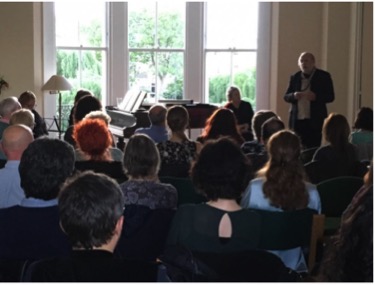
David Less, Chairman of the Abrahamic Reunion Board, speaking at an event organised by Abrahamic Reunion England at the Centre for Counselling and Psychotherapy Education in London.

David Less, Chairman of the Abrahamic Reunion Board, speaking at an event organised by Abrahamic Reunion England at the Centre for Counselling and Psychotherapy Education in London.

This was the third speaking tour to the UK that The Abrahamic Reunion’s International Executive Directors, Dr. Anna Less and Ghassan Manasra, have done on behalf of the Abrahamic Reunion. Anna’s husband David Less, another founding member and Chairman of the Board, accompanied them on part of this tour to hold a fundraiser in London for the Abrahamic Reunion, England.

While in London Anna, Ghassan and David worked with the AR UK team, founded by the Abrahamic Reunion England board members, Amanda and Michael Kenton.

This tour included speaking engagements at a prison, a synagogue, an interview on BBC radio, and many other exciting events coinciding with the beginning of Ramadan.

Darkness cannot drive out darkness; only light can do that. Hate cannot drive out hate; only love can do that.
Martin Luther King, Jr.

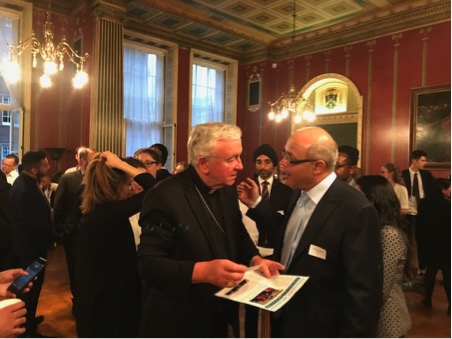
Catholic Cardinal of the UK with Sheik Ghassan Manasra at the Catholic Archbishop’s House in London.

We can never obtain peace in the outer world until we make peace with ourselves.
Dalai Lama

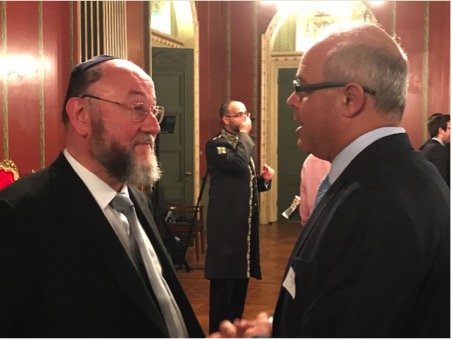
London Interfaith Iftar with Ephraim Mirvis, the Chief Rabbi of the United Hebrew Congregations of the Commonwealth, and Sheik Ghassan Manasra of the Abrahamic Reunion at the Catholic Archbishop’s House in London.

Man must first create peace in himself if he desires to see peace in the world; for lacking peace within, no effort of his can bring any result.
Hazrat Inayat Khan